

For Dawn Loo, Loo's Hainanese Curry Rice was worth every sacrifice
The third-generation owner on choosing legacy over comfort, and earning her place one change at a time.


A plate of Hainanese curry rice lives and dies by its gravy. The good ones are rich and layered, with a depth that lingers well after the last bite. At Loo’s, that depth comes from a curry paste made entisrely from raw ingredients, no powder, no shortcuts, ground by hand and cooked in batches that take three days to produce. The recipe hasn’t changed in 80 years. Neither have the vendors.
Dawn Loo joined the stall full-time in 2025. She’s 30, holds a social work degree, and had a civil service job offer on the table when she made the call. She turned it down to be here at 5am, learning how to pack a plate.
The long way round
Dawn didn’t grow up wanting this.
As a child, she avoided the stall whenever she could. F&B felt unglamorous, the work dirty and thankless. The feeling crystallised early, in a primary school classroom, when a teacher asked students what their parents did for a living. Her friends’ parents were bankers, lawyers, doctors. Dawn’s dad was a hawker. Some of her classmates laughed.
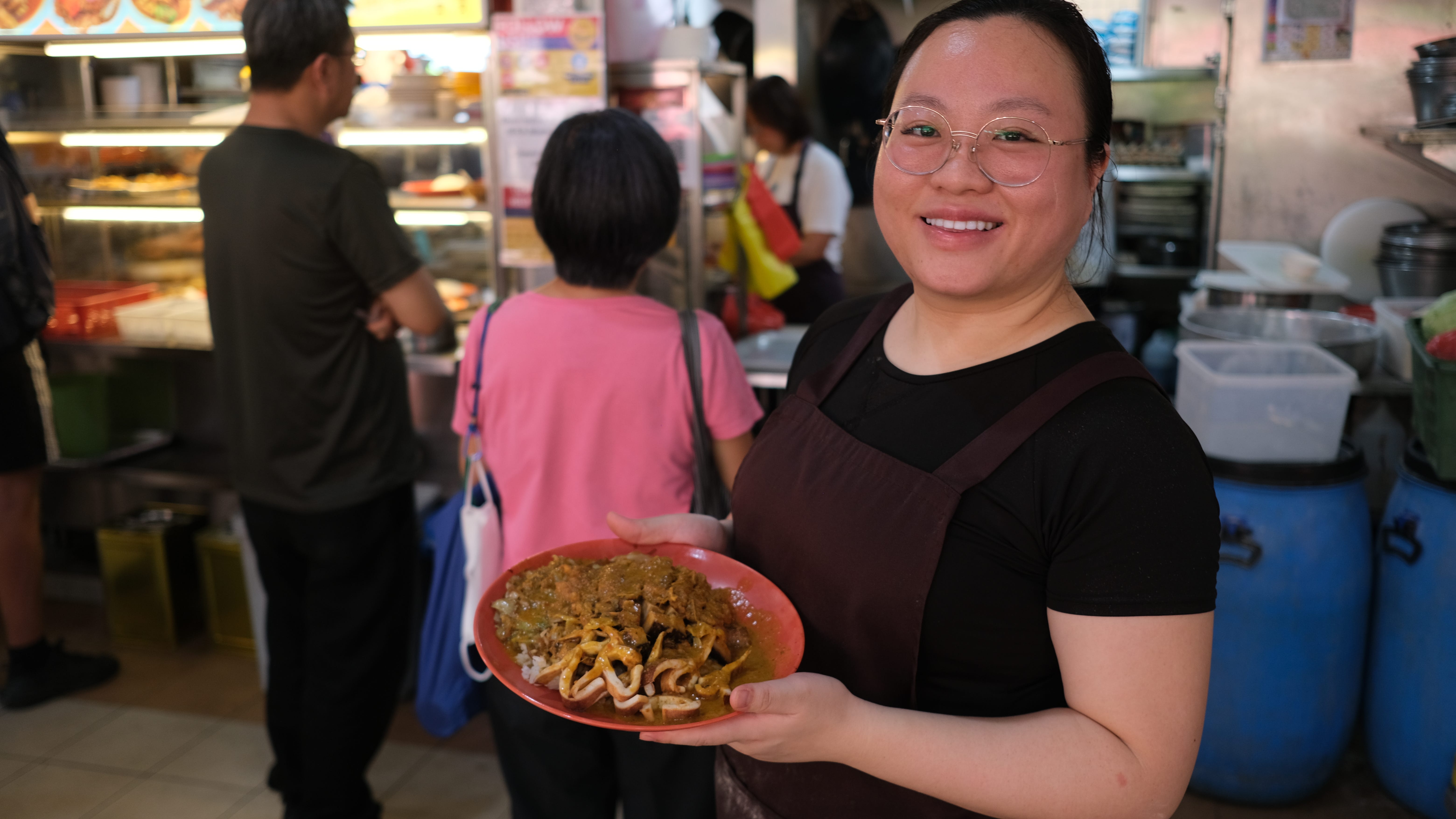
She spent the next two decades building a different life. A degree in social work. A stint in academia. A career that had nothing to do with curry rice. It was only in her 20s that she gave the stall serious thought. Around 2023, she went back for a nine-month apprenticeship, mostly on the front line — cashiering, food packing, customer service. “At that time, I was quite certain I wouldn’t take over the business,” she recalls. She needed time to reassess. When she came back, the decision was clear.
She told her father she wanted to take over. He said no.
His reasoning was simple: he’d spent decades in the trade and knew exactly what it demanded. “He doesn’t want me to suffer,” Dawn says. It took persistence on her part, and a knee surgery on his, before he finally relented. By then she’d already secured a civil service job offer. She had every reason to take it. She came to Tiong Bahru instead.
Earning the room
When Dawn returned full-time in 2025, the reception was cautious. The stall ran with a team of older workers, most of them at or near retirement age. Her arrival read as a threat. With six people already at the stall, the concern was straightforward: was she there to replace someone?
She didn’t try to resolve it with words. She showed up at 5am. She learned to cook. She watched and waited. It took about six months before she sensed a shift, and when it came, it wasn’t verbal. “They will start to talk to me, or try to teach me things,” she says. “I can sense the difference in the attitude, the tone.”
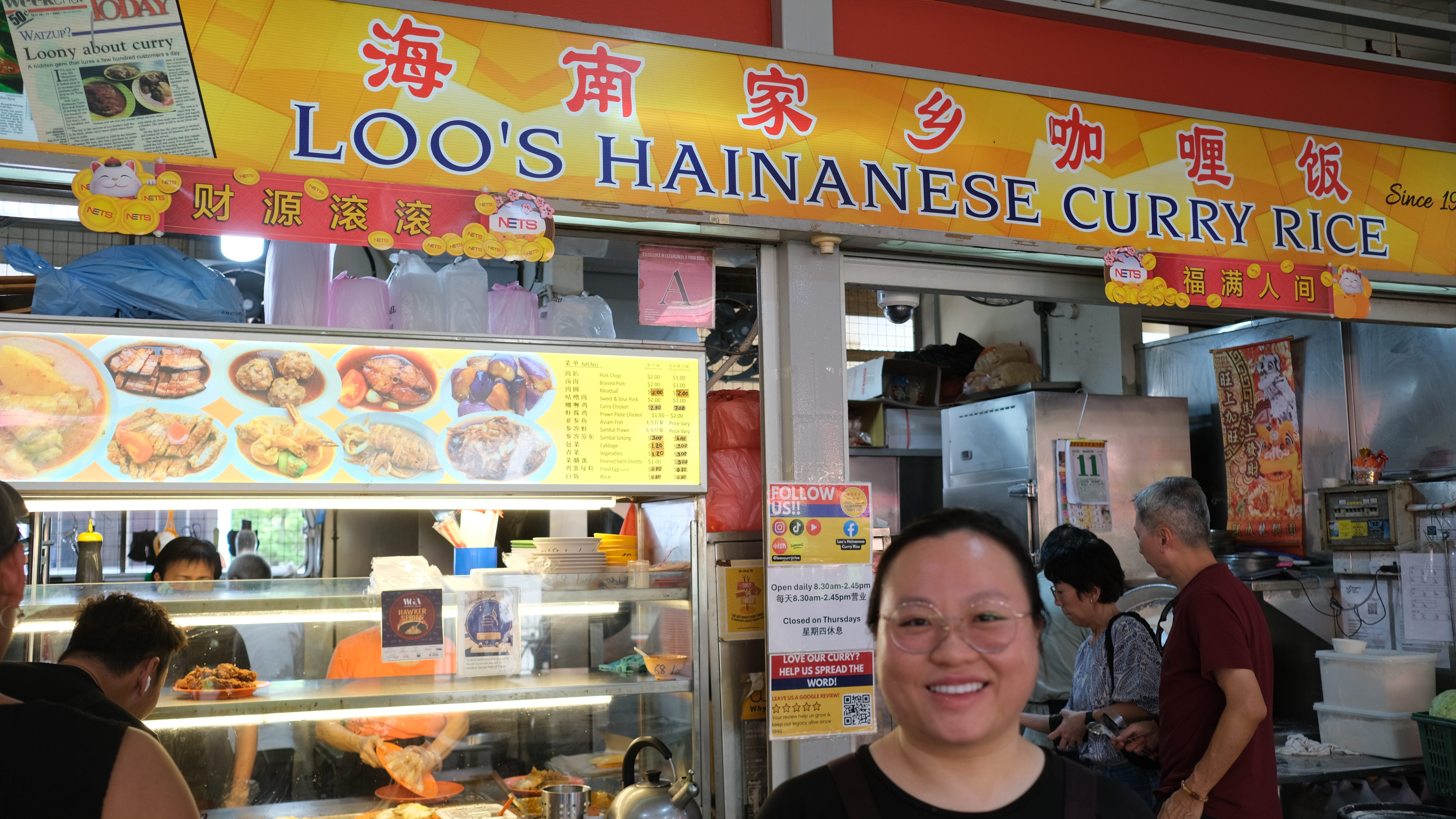
The operational side presented its own version of the same challenge. Pricing at the stall had always been done from memory, the same way it had been done since her grandfather’s time. To Dawn, it was messy. To her father, it worked. “Change takes time,” she says. “It’s like, I’m this person who just came in all of a sudden. What’s wrong with you, right?” She knew better than to push.
Instead she started small. PayNow. A QR code for digital payments. Each time, she waited for the sales to reflect the change before proposing the next one. “When my dad sees the sales going up, that’s where he will trust me,” she said. A POS system, her most ambitious idea yet, is already mapped out in her head. The kitchen is too noisy for servers to hear orders clearly, she explains, and a ticketing system would fix that without sacrificing the human interaction she thinks hawker stalls can’t afford to lose. For now, it stays on the backburner. Six months in, two changes implemented. “Maybe when the right time comes, I’ll propose this again,” she says.
The 80-year recipe
Not everything is up for negotiation.
The curry paste is made from raw ingredients, ground by hand, cooked in batches that take three days to produce. The vendors are the same ones Dawn’s grandfather sourced from. The recipe hasn’t been touched in 80 years. “We cannot anyhow tweak, cannot anyhow change supplier, because it will affect the taste and the integrity of our recipe,” she says. “My dad has always emphasised: cannot take the shortcut, cannot choose a cheaper supplier.”
Dawn has made this position her own. Where she’s willing to push on operations, payments, and process, the food itself is a different matter. Cheaper options exist. The choice not to take them is made every day.
It’s a stance that sits uneasily against a broader problem Dawn is candid about: hawker food has been branded as cheap for so long that customers no longer know what it actually costs to make. The sambal prawn draws complaints about its price. The curry gravy draws questions about portion sizes. “They don’t understand the cost,” she says. “It’s all invisible to them.” The irony isn’t lost on her. The very things that make Loo’s curry rice worth eating — the raw ingredients, the three-day process, the refusal to cut corners — are precisely the things nobody sees.
Changing that narrative, Dawn believes, will require more than good food. “We need to start telling that story,” she says. Behind-the-scenes content, she thinks, is probably where it begins.
The next 20 years
Dawn is six months into running the stall full-time. Her growth ambitions are sequenced and deliberate.
Near term, the priority is simple: maintain the standard. “The most important thing right now is to maintain the standard and the quality,” she says. Evening service is a possibility. Food fairs, where she can experiment with more modern takes on curry rice, are on the table. Further out, more hawker stalls. And eventually, 10 to 15 years from now, something more upscale — a restaurant or fine dining offshoot, a completely separate branch that brings Hainanese curry rice into a different context entirely.
The idea she keeps coming back to, though, is food tours. Dawn wants to bring tourists into the stall, walk them through the process, show them why the curry takes three days. It’s partly commercial, partly something larger. Ask most people to name Singapore’s iconic dishes and they’ll say chicken rice, laksa, chilli crab. Hainanese curry rice, a dish that originated here, rarely makes the list. “Nobody will say curry rice,” she says. “I want to change that narrative.”
No tour operator has approached the stall. Dawn knows she’ll have to go looking. She’s used to not waiting to be asked. The goal she’s working toward is 100 years — 20 more than where the stall stands today. It’s an ambitious target, and she knows it. “I will try to make it work,” she says, “because I know what I want to achieve.”
At the end of our conversation, I ask Dawn what gives her the confidence that it’ll all come together. The 100-year mark. The food tours. The upscale offshoot a decade and a half away.
She laughs. “Maybe a bit delusional,” she says. “But I feel like it’s important to be delusional. So that you have the motivation to work towards it.”
It’s a candid admission from someone who has spent the last six months arriving before dawn, learning a trade she once found embarrassing, and negotiating her way into a room that wasn’t sure it wanted her. The delusion, if that’s what it is, has been remarkably well-organised so far.