

How Singapore's hawker centres lost the morning
For newer joints, removing the wet market killed the breakfast crowd.


📌 Table Stakes is a bi-weekly analysis that examines the broad market trends shaping Southeast Asia's F&B scene. Go to Singapore’s Tiong Bahru Market on a Tuesday at seven in the morning.
The wet market downstairs is already three hours in. Fishmongers are wrapping orders. The tofu uncle is restocking. An auntie haggles over kangkong. When she is done, she walks upstairs, takes a seat, and orders her usual kopi. The stall owner already knows what she wants.
That sequence — wet market errand, then breakfast — is how Singapore’s hawker centres were designed to work. It is also what most of the country’s newest hawker centres were built without.
The wrong diagnosis
The standard explanation for why hawker centres struggle covers aggressive rents, soaring ingredient costs, ageing hawkers, and razor-thin margins. All of these issues are real.
But they don’t explain the root of the struggle. Chinatown Complex, Singapore’s largest hawker centre with over 260 stalls, draws long queues throughout the day; Tiong Bahru Market is one of Singapore’s busiest, particularly at breakfast and lunch. The centres that are genuinely struggling are the newer ones, built since 2011 in outer estates like Hougang, parts of Jurong West, and newer towns up north and west.
The problem with those hawker centres follows a very specific pattern. The crowds stream in at lunch, but these joints are virtually dead quiet in the mornings.
Clearly, something is missing from the mornings.
Groceries, then makan
When Singapore’s government built hawker facilities alongside wet markets from the 1960s onward, the pairing was deliberate. The official reason was hygiene — getting street hawkers into regulated spaces. But an economic logic came with it.
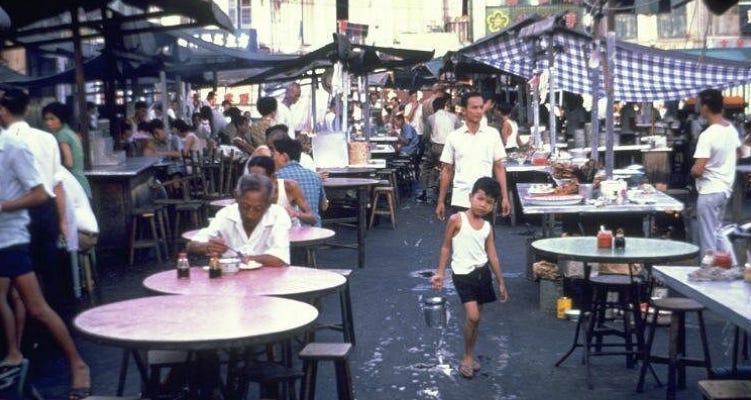
The wet market gave residents a reason to leave the flat before sunrise. Buying the day’s fish and vegetables was the first errand. Breakfast upstairs was the second. The two were bundled into one trip. Done often enough, the trip became routine. The same faces at the same stalls, the same kopi order without asking.
This is what the wet market was providing to hawker floors. National Geographic describes the morning hawker scene as seniors gathering to read papers and sip from saucers. Hawkers greet regulars and remember what they order. These people didn’t decide to visit a hawker centre that morning. They went to buy fish, and breakfast came with it.
A breakfast-only stall runs on exactly this kind of crowd. A chwee kueh stall or kaya toast counter has a four to five hour window. Stalls at Tiong Bahru like Lor Mee 178 draw queues from opening until early afternoon, then stop. There’s no dinner service to recover losses. If the morning crowd is thin, the day’s already over.
Since 2011, the Singapore government has opened 14 new hawker centres. Twelve of them have no attached wet market. The official position, stated in parliament, is that new hawker centres will generally not include a market section, given the availability of supermarkets and HDB produce shops. But the supermarket argument only addresses produce access. Two other assumptions appear to underpin how new centres were planned, even if never stated explicitly.
On produce, the official reasoning is that supermarkets will fill the gap. But as Singapore University of Technology and Design Associate Professor Lyle Fearnley notes, supermarkets serve younger working people who cannot shop on weekday mornings — a different crowd from wet markets entirely. NEA’s own data shows most wet market patrons are 60 years old and above, and they come early. A supermarket open at eight in the evening doesn’t produce a breakfast crowd at seven in the morning.
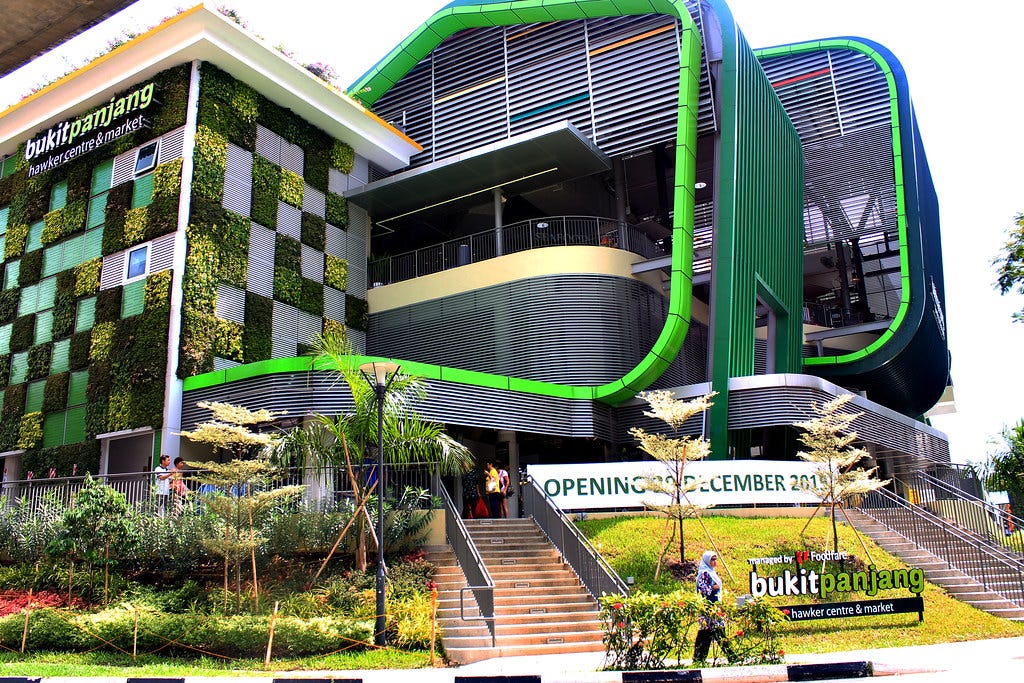
The second assumption is that nearby residents will show up. New centres were planned around residential catchment size. But proximity alone doesn’t create habit. Ci Yuan in Hougang and Bukit Panjang Hawker Centre have both been reported as struggling with low daytime footfall. The wet market doesn’t just bring people nearby — it gives them a reason to routinely leave home in the first place.
The final assumption is that MRT access naturally generates foot traffic. That logic applies for lunch and dinner (sometimes), given that MRT stations deliver commuter spikes during rush hour. On the other hand, wet markets catered to slow, local morning traffic from people who had just finished getting their groceries, and were in no hurry to head off elsewhere. These customers are precisely who breakfast stalls need.
What the exceptions reveal
Tiong Bahru has a wet market below the food centre. Chinatown Complex has one in the basement. Both are among Singapore’s most consistently patronised centres.
Two of the 14 new centres also have wet markets: Fernvale and Bukit Panjang. What happened at Bukit Panjang is particularly instructive.
Bukit Panjang opened in 2015 with a hawker floor and a wet market. Things worked out at first, until Then a minimart on the same floor as the wet market closed in 2018. Within months, wet market vendors reported foot traffic collapsing and sales dropping by up to 50 per cent. Seafood that used to sell out in one to two hours sat unsold at the end of the day. The minimart had been an anchor errand, and its closure cost the wet market spillover traffic that sustained it. Consequently, the hawker floor above felt the same effect.
Kampung Admiralty, a newer centre in Woodlands, had a similar setup: a wet market below the hawker floor, but also complete with elderly housing, a medical centre, a childcare centre, and direct MRT access. The building was designed as an integrated community space, with light flowing from the hawker floor down into the wet market below — a full ecosystem of morning errands for the population most likely to be there before eight. Kampung Admiralty’s success stems from how the centre gives residents multiple reasons to show up before the lunch rush. The struggling centres have none of that.
But wait - haven’t Lau Pa Sat, Amoy Street Food Centre, and Old Airport Road thrived without wet markets? Yes, but the catch is that all three are near the CBD, drawing office workers and tourists at volumes a neighbourhood centre in a new outer estate cannot match. These CBD joints compensate for the weak morning demand with a different pull - decades of reputation, iconic stalls, high-density daytime population. New outer-estate neighbourhood centres have none of that, and the planning framework doesn’t give them a substitute.
A self-reinforcing decline
There are 83 wet markets left in Singapore, and the trend is pessimistically downward. Younger residents prefer supermarkets. Stallholders are ageing — NEA reports the median age of market stallholders is now 63. Operating hours are shrinking.
Singapore’s government has treated wet market decline as a separate issue from hawker viability, but they’ve always affected each other. When wet market attendance drops, so does the morning crowd upstairs. Fewer regulars means the breakfast stall earns less. If it closes, there’s one fewer reason to come to the centre at all. Wet market attendance drops further. The Bukit Panjang case clearly illustrated this relationship.
The breakfast hawker sits at the end of this chain with the least margin for error. Prep starts at two in the morning. Dishes cost two to four dollars. Margins are tightening and so is their operating window. Few pivot to delivery, and none can count on the evening service to make up for weak morning demand. These stalls need the kind of regular, local, unhurried morning crowd that the wet market reliably produced. They can’t survive on transit footfall or passing lunch patrons. They’re already disappearing from centres where the bundle was broken, and holding on in the ones where it remains intact.
Singapore has committed a billion dollars to hawker centre upgrades and new builds. The NEA has acknowledged that footfall and patronage are equally important alongside costs, and that centres in good locations do well. Kampung Admiralty is what that looks like in practice. But good location, in that sense, means something specific: a place with multiple community anchors that give people a reason to be there before noon.
What’s missing from most new centres is a morning anchor: a specific reason for someone to leave their flat before sunrise, do an errand, and end up sitting at a hawker stall with nowhere to be. Without that, breakfast stalls will struggle to find reprieve.